

In today’s volatile and fast-paced business environment, the role of a consultant has shifted from a reactive problem-solver to a proactive strategic partner. For consulting firms, “staying ahead of the curve” is no longer an aspiration—it’s a survival imperative. To deliver enduring value to clients and maintain a competitive edge, firms must anticipate disruptions, embrace radical innovation, and fundamentally reshape their service delivery models.
Here are the key strategies that will define the leading consulting firms of tomorrow.
The integration of Artificial Intelligence (AI) and advanced analytics is not just a tech trend; it’s a paradigm shift in how consulting is delivered. The firms that will lead are those that move beyond simply advising on AI to becoming AI-enabled enterprises themselves.
From Hindsight to Foresight: By harnessing the power of generative AI and predictive analytics, consultants can process vast datasets to identify patterns and predict market trends with unprecedented speed and accuracy. This allows for the creation of proactive strategies rather than reactive solutions.
Augmenting Human Expertise: Automation can handle routine tasks like data collection and initial analysis, freeing up consultants to focus on high-value, strategic thinking, creative problem-solving, and relationship-building. The future lies in a human-in-the-loop model where AI amplifies consultant capabilities.
Sustainability and Environmental, Social, and Governance (ESG) criteria have moved from the periphery to the center of corporate strategy. Clients are no longer just asking for compliance; they need comprehensive strategies to navigate the transition to a sustainable future.
Consulting firms must build deep expertise in areas such as decarbonization pathways, circular economy models, and social impact assessment. By helping clients align profit with purpose and meet evolving regulatory and stakeholder expectations, firms can position themselves as essential long-term partners.
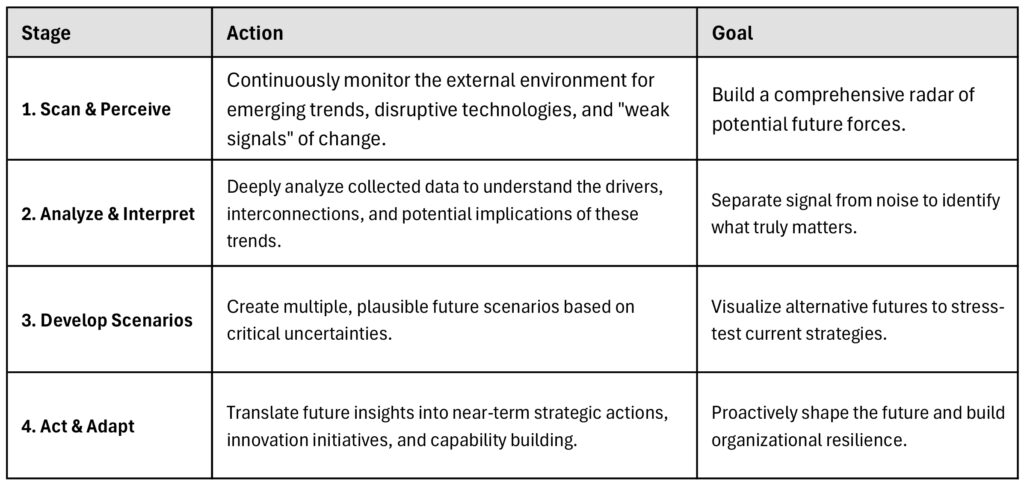
To truly stay ahead, consulting firms must develop a formalized capability for strategic foresight—the disciplined practice of anticipating and preparing for long-term future trends. This goes beyond traditional market research. It involves systematically scanning for weak signals of change across social, technological, economic, environmental, and political (STEEP) domains.
By developing plausible future scenarios, firms can help clients “stress-test” their current strategies and identify new growth opportunities before they become obvious to the wider market.
The Strategic Foresight Cycle
The following chart illustrates a continuous cycle that consulting firms can implement to institutionalize foresight and turn future signals into present-day strategic advantage.
The era of one-size-fits-all consulting frameworks is over. Clients now expect highly tailored solutions that address their specific context and deliver measurable return on investment (ROI).
Client-Centricity: Firms must invest time in deeply understanding a client’s unique culture, challenges, and objectives to co-create solutions that enjoy broad internal buy-in.
Focus on Outcomes: Shift from pricing based on time and materials to pricing based on tangible results and value delivered. This aligns the firm’s incentives with the client’s success and fosters a true partnership.
The speed of change means that the skills required today may be obsolete tomorrow. A consulting firm’s most valuable asset is its people, and investing in their continuous development is paramount.
Firms must foster a culture of continuous learning, encouraging consultants to upskill in emerging areas like data science, AI ethics, and sustainable business practices. Furthermore, adopting agile delivery models—embracing remote and hybrid work—allows firms to tap into a global talent pool and deploy the right expertise to the right client at the right time.
Staying ahead of the curve is not a destination but a continuous journey of adaptation and reinvention. By integrating AI, championing sustainability, mastering strategic foresight, delivering personalized value, and nurturing an agile workforce, consulting firms can not only navigate the uncertainties of the future but also actively shape it for themselves and their clients. The firms that succeed will be those that are as visionary as they are practical, turning future insights into today’s competitive advantage.

© 2025 SBF Consultants. All Rights Reserved.